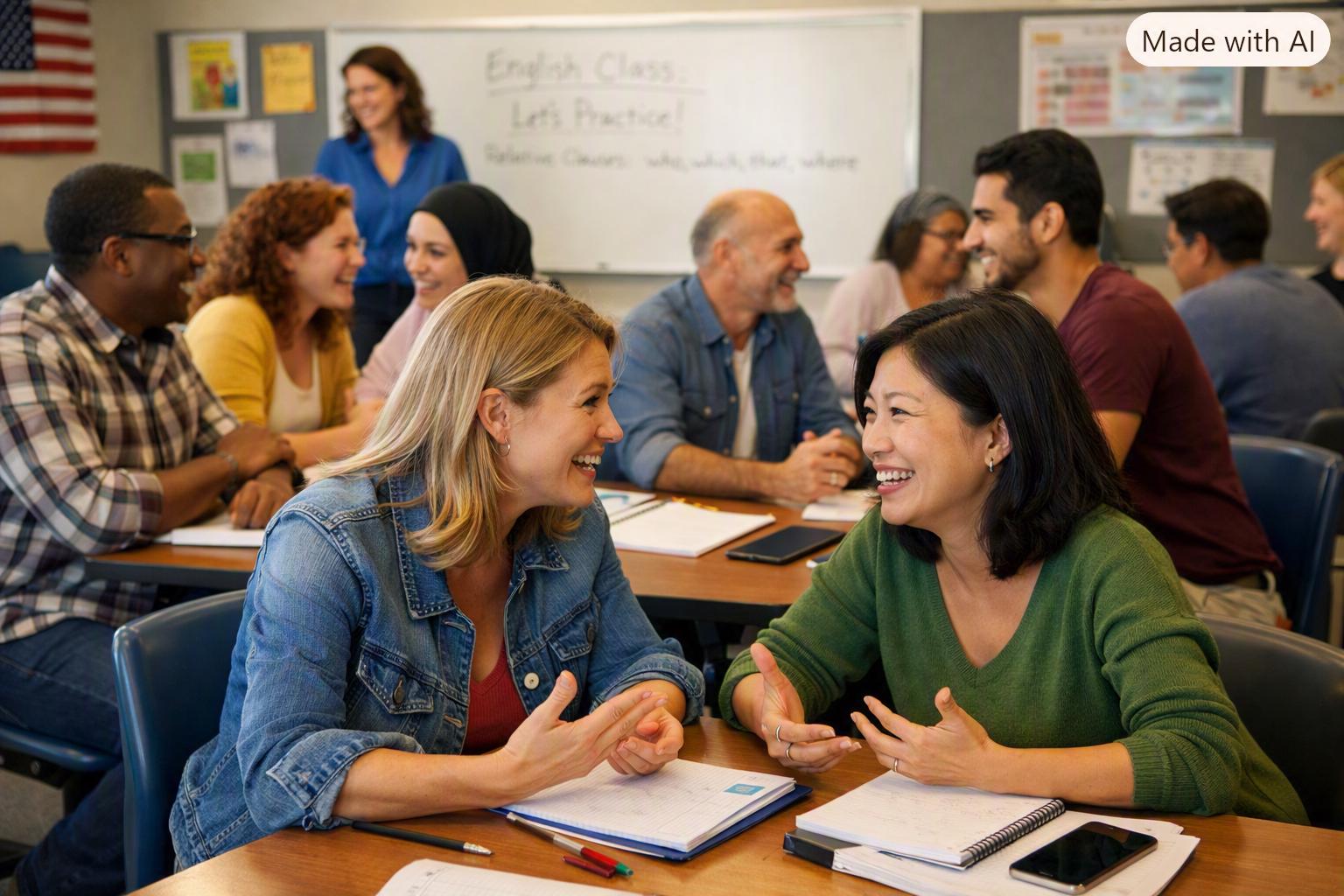
There is a particular kind of magic that happens in an ESL classroom that rarely gets talked about. It isn't just grammar drills and vocabulary lists. It's something closer to diplomacy — quiet, patient, unglamorous diplomacy, conducted one conversation at a time.
The Classroom as Common Ground
Picture a lesson with a student from Seoul, another from São Paulo, and a third from Riyadh, all sitting in the same virtual room, reaching for the same language to describe their lives. None of them owns English. None of them is fully at home in it either. That shared unfamiliarity flattens the usual hierarchies. Nobody gets to claim the high ground of "this is my language, you're a guest in it." Everyone is building the bridge together, plank by plank, out of borrowed materials. That's not a small thing. So much of the friction between cultures comes from a simple, fixable failure: not having a shared way to talk to each other. Give people a common tongue, even an imperfect one, and suddenly they can ask each other the questions that actually matter — what do you eat for breakfast, what does your grandmother say when you're sick, what does it feel like when your team loses.
Curiosity as Curriculum
Every ESL teacher knows that the best lessons rarely stay on script. You ask a student to describe their weekend, and instead you get a story about a wedding with seventeen courses of food, or a festival where the whole town turns out with lanterns, or a grandfather who still tells the same three jokes every holiday. The textbook wanted past tense practice. What actually happened was an exchange of worlds. This is where teaching quietly becomes peacemaking. Peace, at the everyday level, isn't signed on paper — it's built through the accumulation of a thousand small moments where a stranger's life stops being abstract and starts being specific. It's much harder to hold a caricature of "people from that country" in your head once you've spent forty-five minutes laughing with one particular person from that country about how confusing English prepositions are.
Translation Is Never Just Translation
Anyone who has taught language for long enough learns that you are never only teaching words. You are constantly translating context: why a direct question might sound rude in one culture and refreshingly honest in another, why silence means agreement in one classroom and confusion in the next, why a joke that kills in one place falls flat in another. Good ESL teachers become, almost by accident, cultural interpreters — helping one student understand not just what another student said, but what they meant, and why they said it that way. That interpretive work is diplomacy in miniature. It's the same skill a UN translator uses, scaled down to a classroom of a dozen people trying to be understood.
Humility Goes Both Ways
The other quiet gift of this work is what it does to the teacher. Standing in front of learners from a dozen backgrounds has a way of stripping away assumptions about whose customs are "normal" and whose are "foreign." You start to notice how many of your own habits are just as arbitrary and culturally specific as anything you're asking your students to explain. Teaching English abroad or online doesn't just export a language — it imports perspective right back at you. That exchange, done honestly, isn't one-directional. It's not "we'll teach you our language and you'll teach us your customs" in some transactional sense. It's messier and better than that: everyone in the room walks away slightly changed, slightly less certain of their own defaults, slightly more curious about everyone else's.
Small Rooms, Wide Reach
None of this requires a classroom of hundreds or a curriculum designed by a committee. It happens in one-on-one Preply lessons and in short TikTok clips just as much as anywhere else. A single well-taught lesson that helps someone finally feel comfortable ordering coffee in a new country, or writing an email to a coworker abroad, or understanding a joke in a language that used to intimidate them — that's a small act of connection. Multiply it by the thousands of lessons happening every day, all over the world, and you start to see something bigger: a quiet, decentralized peace process, run not by diplomats but by teachers. Teaching English isn't going to solve the world's conflicts. But it does something real and underrated: it gives people a reason and a means to understand each other a little better than they did before class started. In a world that often seems better at building walls than bridges, that's not nothing. It might even be the point.
Allen